
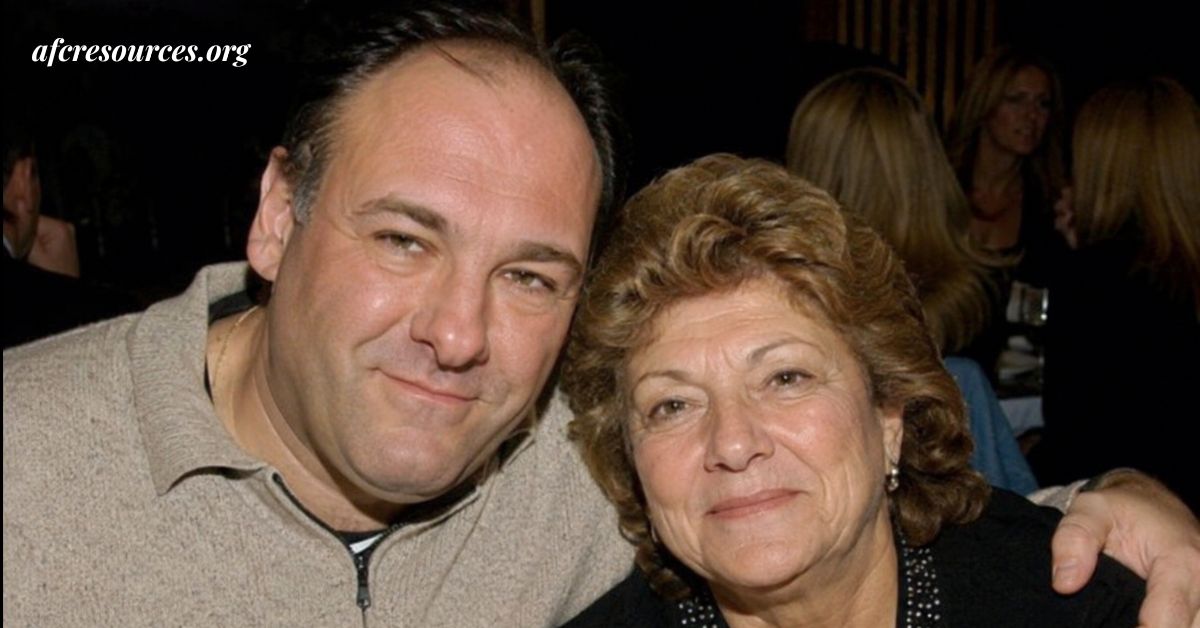
Behind every great performer is a story that began long before the cameras rolled. Behind James Gandolfini the man who would become one of the most celebrated actors in television history stood Santa Gandolfini, a quiet, strong, and deeply devoted woman whose life and values shaped everything her son would become.
Santa Gandolfini is not a name that appears on award show stages or in entertainment headlines. But she is a name that belongs in any honest conversation about James Gandolfini’s life because without her, the man who gave the world Tony Soprano may never have found the depth, the grit, and the humanity that made his performance so unforgettable.
This is her story.
The Woman History Almost Forgot
I have spent years fascinated by the people behind famous people the parents, siblings, and quiet figures whose influence runs through a celebrated life like a thread that holds everything together but remains invisible to most observers.
When I began researching James Gandolfini’s background in depth, I kept returning to one figure. His mother. The woman he spoke about with a particular kind of reverence that told you everything about how much she meant to him. The woman whose passing, just years before his own too-early death, left a visible mark on everything he said about family, loyalty, and where he came from.
Santa Gandolfini deserves to be known. Not as a footnote in her son’s biography but as a person whose own life was remarkable, whose journey from Manhattan to the suburban landscapes of New Jersey represented something genuinely American, and whose love for her children produced one of the most gifted actors the world has ever seen.
Who Was Santa Gandolfini — Early Life and Origins
Santa Gandolfini was born in November 1923 in Manhattan, New York County one of the most vibrant, chaotic, and culturally rich places in the world at that moment in history. The Manhattan of the 1920s was a city of immigrants, ambition, and neighborhood identity. It was a place where communities built themselves around shared heritage, shared language, and shared struggle.
The 1920s and 1930s in New York were not easy decades for working families. The Great Depression cast a long shadow over the childhoods of an entire generation. Santa grew up in an era that demanded resilience, resourcefulness, and a kind of practical strength that later generations would rarely need to develop in the same way.
She came from Italian-American roots — part of the vast and culturally rich wave of Italian immigration that had transformed New York’s neighborhoods in the early twentieth century. The values of that community family above all, loyalty, hard work, dignity in the face of hardship were not abstract principles. They were daily practice. They were survival.
These were the values Santa Gandolfini carried with her throughout her life. And they are the values she passed directly to her son.
The World Santa Gandolfini Lived Through
To understand Santa Gandolfini as a person, you need to understand the historical landscape she navigated across her seventy-three years of life.
Born in 1923, she lived through the full sweep of twentieth century American experience. The Great Depression of the 1930s. The Second World War. The postwar boom that transformed American suburban life. The social upheavals of the 1960s and 1970s. The economic pressures of the 1980s. And the dawn of the digital age in the 1990s a world almost unimaginably different from the Manhattan neighborhood where she had been born.
This was a generation that knew hardship intimately and did not dramatize it. They worked. They built. They raised their children with a directness and a practicality that came from genuine experience of how quickly circumstances could change.
Santa’s generation the children of immigrants who grew up through the Depression and came of age during wartime produced a particular kind of American character. Tough without being cold. Loving without being sentimental. Clear about what mattered and uninterested in what did not.
James Gandolfini carried those qualities on screen in everything he did. They did not come from acting classes alone. They came from watching his mother live them every single day.
Santa Gandolfini as a Mother — The Foundation She Built
The Gandolfini family settled in New Jersey part of the great movement of Italian-American families from New York’s urban neighborhoods into the suburban communities that grew rapidly in the postwar decades. It was a transition millions of families made, trading the intensity of city life for something quieter, more stable, and more oriented around schools, churches, and community.
James Gandolfini was born in 1961 the son Santa raised alongside his sisters in this New Jersey environment. By all accounts, the Gandolfini household was defined by the qualities that Santa embodied: warmth, directness, high expectations, and an unspoken but deeply felt emphasis on loyalty and family obligation.
James Gandolfini spoke about his mother in interviews with a particular kind of careful reverence — the way people speak about someone whose influence they can feel but struggle to fully articulate. He was not a performer who came from a theatrical family or a world of artistic ambition. He came from a working, ordinary, deeply rooted Italian-American household where the values were traditional and the expectations were clear.
That grounding that deep familiarity with ordinary human struggle, loyalty, contradiction, and love is exactly what made his portrayal of Tony Soprano so transcendent. Tony Soprano was not an alien figure to James Gandolfini. He was built from elements that James understood in his bones. And the foundation of that understanding was laid by Santa.
The Legacy of an Italian-American Mother in Mid-Century New Jersey
The story of Santa Gandolfini is in many ways the story of an entire generation of Italian-American women whose contributions to their families and communities were enormous and almost entirely unrecorded.
These were women who held households together through economic uncertainty, who maintained cultural identity across generations in a new country, who cooked and cleaned and worked and prayed and argued and loved with an intensity that the polished surfaces of suburban American life sometimes struggled to contain.
They were not glamorous figures. They were not celebrated publicly. But they were the architecture of the lives their children built.
The Italian-American community in New Jersey that shaped James Gandolfini’s early life and that he drew on so powerfully in his work was built by people like Santa. Their food, their voices, their arguments, their silences, their particular way of expressing love through action rather than declaration all of this lived in James Gandolfini’s performance in ways that resonated with millions of viewers who recognized it from their own families.
When audiences watched Tony Soprano sit at the kitchen table, eat, argue, and love badly and fiercely many of them were watching something true about their own mothers, grandmothers, and the worlds those women built. Santa Gandolfini was part of that truth.
Santa Gandolfini’s Final Years and Passing
Santa Gandolfini passed away in January 1997 at the age of seventy-three just as her son’s career was approaching the moment that would define it. The Sopranos, the role that would make James Gandolfini one of the most celebrated actors of his generation, began airing in 1999 two years after his mother’s death.
She never saw him become Tony Soprano. She never saw the Emmys, the Golden Globes, the cultural conversation that her son’s work ignited. She never saw the full flowering of the talent she had helped shape.
That fact carries a particular weight. James Gandolfini spoke in later interviews about his mother’s absence in ways that suggested it was something he carried with him a presence defined partly by its loss. The show that made him famous was in many ways a meditation on exactly the kinds of families, loyalties, and contradictions that Santa Gandolfini represented in his own life.
She passed before she could see it. But her influence was there in every frame.
What Santa Gandolfini’s Life Teaches Us
The life of Santa Gandolfini from her birth in Manhattan in November 1923 to her passing in New Jersey in January 1997 is a life that mirrors the lives of millions of women whose stories are rarely told separately from the famous people they raised.
She was born into a world of struggle and built a life of dignity. She raised children in the honest, demanding, loving tradition of Italian-American working families. She gave her son a foundation of human understanding so deep and so true that he was able to build one of the most complex and compelling characters in the history of American television from it.
Her story matters not because of who her son became though that is extraordinary. It matters because her life itself was full, real, and representative of an entire generation of women whose quiet strength built something lasting.
Frequently Asked Questions About Santa Gandolfini
Who was Santa Gandolfini?
Santa Gandolfini was the mother of acclaimed American actor James Gandolfini, best known for his role as Tony Soprano in the HBO series The Sopranos. She was born in November 1923 in Manhattan, New York County, and passed away in January 1997 at the age of seventy-three.
Where was Santa Gandolfini born?
Santa Gandolfini was born in Manhattan, New York County, in November 1923. She was part of the Italian-American community that formed a significant and culturally rich part of New York’s population in the early twentieth century.
When did Santa Gandolfini die?
Santa Gandolfini passed away in January 1997 at the age of seventy-three approximately two years before her son James Gandolfini achieved worldwide fame through his role in The Sopranos, which began airing in 1999.
What was Santa Gandolfini’s background?
Santa Gandolfini came from Italian-American roots part of the Italian immigrant community that shaped the culture and character of New York and New Jersey throughout the twentieth century. She raised her family in New Jersey after the family moved from New York, as many Italian-American families did during the postwar decades.
How did Santa Gandolfini influence James Gandolfini’s career?
While Santa Gandolfini was not involved in the entertainment industry, her influence on James Gandolfini was profound and personal. The values, character, and deep familiarity with Italian-American family life that she instilled in him formed a foundational part of the human understanding he brought to his acting particularly to his portrayal of Tony Soprano.
Did Santa Gandolfini see her son become famous?
No. Santa Gandolfini passed away in January 1997, two years before The Sopranos began airing in 1999. She did not live to see her son achieve the worldwide recognition and critical acclaim that his role in the show brought him.
Why is Santa Gandolfini significant?
Santa Gandolfini is significant both as the mother of one of America’s greatest actors and as a representative figure of an entire generation of Italian-American women whose strength, values, and sacrifices shaped their families and communities in ways that history rarely records directly. Her story deserves to be told on its own terms.
Conclusion: Santa Gandolfini — A Life That Deserves to Be Remembered
The world knows James Gandolfini. It knows Tony Soprano. It knows the weight, the intelligence, and the raw humanity that James brought to every role he played.
What the world knows less is Santa Gandolfini the woman born in Manhattan in November 1923 who lived seventy-three full years, raised her children with the values of a generation that knew hardship and built dignity from it, and left this world in January 1997 without ever seeing the full extent of what her love and her example had made possible.
She deserves to be remembered not only as James Gandolfini’s mother though that alone would be enough to secure her a place in the story of American cultural life. She deserves to be remembered as a woman whose life was its own complete and meaningful thing. A woman of her time, her community, and her family. A woman whose quiet, unrecorded strength built something that the whole world eventually got to see even if they did not always know where it came from.
